Root of a function
In mathematics, a root of a function f is a number x that turns the value of f to 0:

In mathematics, a root of a function f is a number x that turns the value of f to 0:
For example, one of the roots of is , the only root of is 0, for it's -2.5 and so on.


Because polynomials are also functions, roots are real things.
The fundamental theorem of algebra says every polynomial with complex coefficients has at least one (complex) root. Using the fundamental theorem of algebra and the polynomial remainder theorem together shows that every complex polynomial of degree n has exactly n complex roots, and some of them may be equal.
Root of a polynomial
For first degree polynomials the root is .


For second degree polynomials the roots are: .

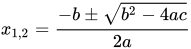
There are also equations for solving 3rd and 4th degrees but Évariste Galois proved that 5th degree polynomials cannot be solved using radicals.
Polynomial remainder theorem states that if is a root of a polynomial If and only if is divisible by .


The Fundamental theorem of algebra states that the Complex plane is an algebraically close Field meaning that any polynomial from degree n has exactly n roots including repeating roots.
If a Polynomial , for , a is a root of P and a root of the first t-1 derivatives of P.


If P is a polynomial such that all of his coefficients are Integers:
1. If a is an Integer root of P, the constant coefficient is divisible by a.
2. If is an Rational root of P, the constant coefficient is divisible by a and the leading coefficient is divisible by b.

For example : P(x) = , we can see that the root should be a divisor of 1 meaning it is 1 or -1, after we check the 2 options we can see that the root is -1.


Content Disclaimer
Informasi ini disarikan dari Wikipedia dan disajikan kembali untuk tujuan edukasi. Konten tersedia di bawah lisensi CC BY-SA 3.0. Kami tidak bertanggung jawab atas ketidakakuratan data yang bersumber dari kontribusi publik tersebut.
- The information displayed on this website is sourced in part or in whole from Wikipedia and has been adapted for the purpose of restating it. We strive to provide accurate and relevant information, however:
- There is no guarantee of absolute accuracy. Wikipedia is an open, collaborative project that can be edited by anyone, so information is subject to change.
- It is not intended to constitute professional advice. The content displayed is for informational and educational purposes only. For important decisions (e.g., medical, legal, or financial), please consult a professional.
- Content copyright. Wikipedia is licensed under the Creative Commons Attribution-ShareAlike License (CC BY-SA). This means that content may be reused with appropriate attribution and shared under a similar license.
- Responsible use. Any risk arising from the use of information from this website is entirely the responsibility of the user.